
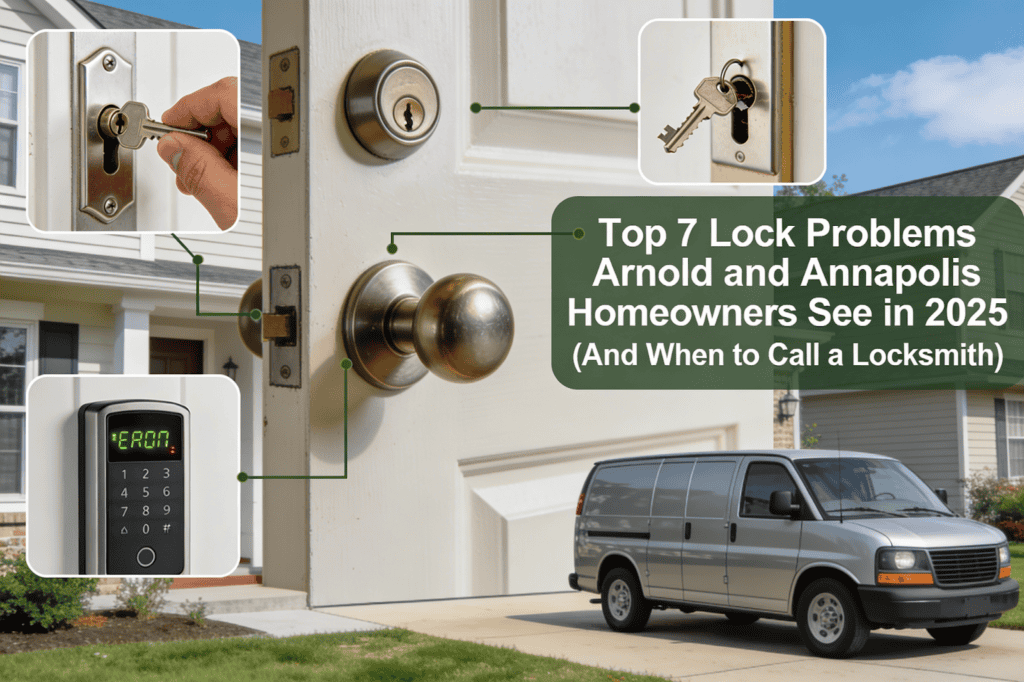
Many homeowners in Arnold and Annapolis deal with the same annoying lock issues every year—sticky deadbolts, doors that will not latch, or smart locks that suddenly stop responding. Knowing which problems you can safely handle yourself and when to call a locksmith can save you time, money, and stress.
Top 7 Lock Problems Arnold and Annapolis Homeowners See in 2025
1. Sticky or hard‑to‑turn deadbolt
A sticky deadbolt is one of the most common lock complaints in 2025, and it usually shows up as a key that is tough to turn or a bolt that will not fully extend. This can be caused by a worn key, dirt and debris inside the cylinder, or a door that has shifted slightly so the bolt no longer lines up correctly with the strike plate.
DIY option: Try a dry graphite or PTFE‑based lubricant in the keyway and test with a freshly cut key if the old one is badly worn.
Call a locksmith if: The bolt still sticks, the door needs hinge or frame adjustments, or the lock shows signs of internal wear or damage.
2. Door will not latch or close properly
If you have to slam the door to get it to latch—or it pops open with a slight push—the problem is often alignment rather than the lock itself. Seasonal humidity around Annapolis, settling foundations, or loose hinges can move the door just enough that the latch no longer lines up with the strike opening.
DIY option: Tighten hinge screws, test whether lifting or pulling the door helps, and lightly adjust the strike plate if you can see obvious misalignment.
Call a locksmith if: The door still refuses to latch, the frame needs more precise adjustment, or you are dealing with a heavy security door that should not be drilled without professional tools.
3. Key turns but the lock does nothing
When a key turns freely without locking or unlocking the door, the internal connection between the cylinder and the lock mechanism may have failed. This issue often appears on older knob locks and deadbolts that have been used for many years or have been forced in the past.
DIY option: There is usually no safe DIY fix beyond verifying you are using the correct key; internal parts need to be repaired or replaced.
Call a locksmith if: The key spins without engaging, because a professional will need to remove the hardware, diagnose the failed part, and repair or replace the lock.
4. Broken key stuck in the lock
Keys can snap off in the lock when metal is weakened over time or when extra force is used on a sticky cylinder. A broken piece left inside the keyway prevents any other key from working and can damage the lock if you try to pry it out with improvised tools.
DIY option: If a portion of the key is visible, you can very gently pull it out with needle‑nose pliers without twisting, but stop if it does not move easily.
Call a locksmith if: The piece is deep inside, you have no clear grip, or the lock was already difficult to turn, because specialized extractors and professional techniques reduce the risk of further damage.
5. Loose door handles or wobbly deadbolts
Handles, levers, and deadbolt housings can work loose over time as screws back out or internal parts wear down. Besides feeling cheap and frustrating, loose hardware can make the door easier to force or even allow the lock to fail entirely.
DIY option: Tighten exposed screws on the interior side of the lock and handle, ensuring the hardware sits flush and solid against the door.
Call a locksmith if: Tightening does not help, the lock still wobbles, or the internal mechanism is clearly worn or partially broken.
6. Smart lock glitches and battery issues
Smart locks are more common around Annapolis in 2025, and with them come new types of problems such as unresponsive keypads, delayed app commands, or locks that randomly stop working. Many of these issues are related to low batteries, weak Wi‑Fi or Bluetooth signals, or software bugs in the app or firmware.
DIY option: Replace the batteries with high‑quality ones, update the lock’s app or firmware, and verify your router or hub signal is strong where the lock is installed.
Call a locksmith if: The lock repeatedly fails, jams, or misbehaves even after battery changes and software updates, or if you suspect the mechanical side of the lock is sticking or misaligned.
7. Cheap or worn‑out locks that no longer feel secure
Even when locks technically still work, many homeowners realize their doors are protected by older, low‑quality hardware that has never been upgraded. Tests and reviews continue to show large differences between the best and worst‑performing residential locks, especially against kicking, drilling, or picking.
DIY option: You can replace basic knobs and deadbolts yourself if you are comfortable with tools and the door is in good condition.
Call a locksmith if: You want to upgrade to higher‑security locks, rekey multiple doors at once, or make sure your new hardware is installed correctly with reinforced strikes and long screws into the frame.
DIY vs calling a locksmith: how to decide
As a rule of thumb, small issues like simple lubrication, tightening visible screws, or replacing batteries are safe DIY tasks for most homeowners. Problems involving broken keys, internal failures, serious misalignment, or repeat smart lock glitches are better left to a professional who has the tools and experience to fix them without damaging doors or hardware.
For homeowners in Arnold and Annapolis, having a trusted local locksmith on call means you do not have to guess—if you are unsure, you can describe the symptoms, send a photo, and get straightforward advice on whether a quick visit will solve the problem. In many cases, a short professional service call restores smooth operation, improves security, and pr